

One lot of Vitruvias Thyroid Tablets USP 30 mg recalled as superpotent
Vitruvias thyroid recall: one lot (504950) of Thyroid Tablets USP 30 mg may be superpotent. See the NDC, expiration date and what patients should do next.
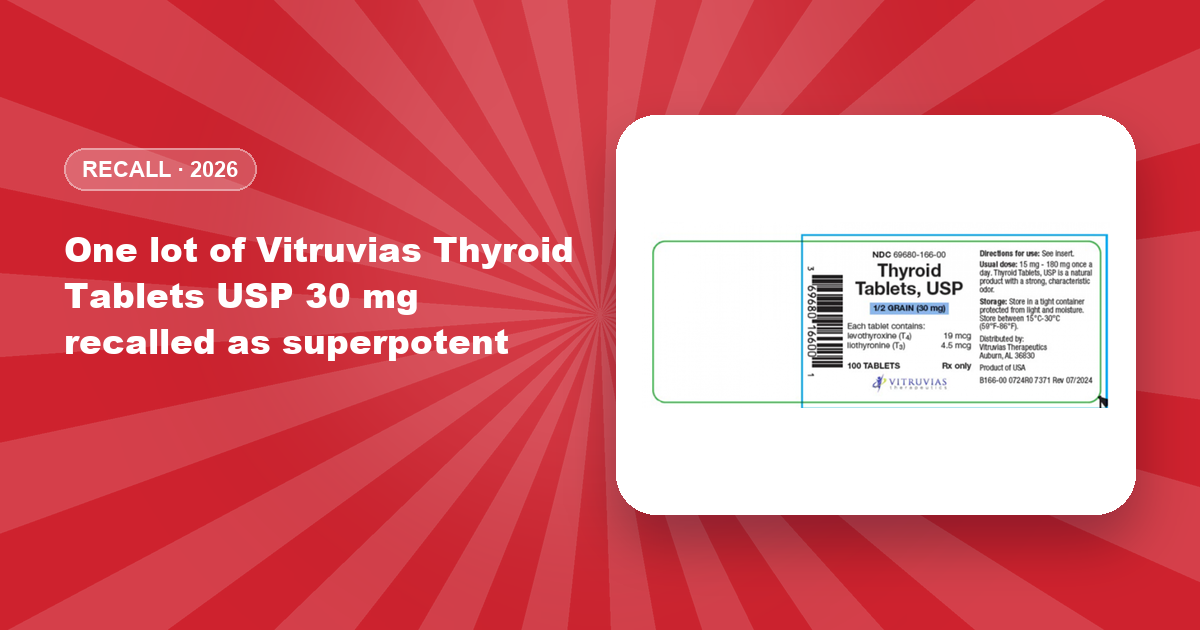
Vitruvias Therapeutics is recalling one lot (Lot 504950) of Thyroid Tablets, USP 30 mg to the consumer level because testing confirmed the potential for the tablets to be superpotent. The company dated the vitruvias thyroid recall Aug. 21, 2026, and FDA posted it on Aug. 24, 2026; it is an active recall, not a September announcement. The lot was distributed nationwide to the company's direct accounts between Jan. 31, 2025 and Sept. 30, 2025, and no adverse events had been reported as of the notice. If you take thyroid tablets from Lot 504950, do not stop taking them on your own: the notice says to contact your healthcare provider for guidance and, if needed, a replacement prescription.
What was recalled
Vitruvias Therapeutics, Inc. of Auburn, Alabama is voluntarily recalling one lot of Thyroid Tablets, USP 30 mg to the consumer level. The affected lot is Lot 504950, NDC 69680-166-00, with an expiration date of 9/30/2026. According to the company's notice, 3,655 units of the lot were released and 1,955 were sold.
Thyroid, USP is described in the notice as a natural preparation derived from porcine thyroid glands, composed of levothyroxine and liothyronine, and used to treat hypothyroidism (underactive thyroid). The notice refers to replacement prescriptions, so most people who have this product received it through a pharmacy rather than off a store shelf.
This is an active recall, not a September announcement. Vitruvias dated its announcement Aug. 21, 2026, FDA posted it on Aug. 24, 2026, and consumer-recall roundups re-listed it on Aug. 28, 2026, which is why it keeps surfacing. Only Lot 504950 is named; the notice does not list any other lots or strengths, so do not assume every Vitruvias thyroid product is affected.
Why the tablets were recalled
The company says the lot is being recalled because testing confirmed the potential for the product to be superpotent, meaning tablets may deliver more thyroid hormone than the label states. The notice does not say how far above labeled strength the tablets tested, or how the issue came to light beyond that testing.
The risk statement in the notice explains why that matters. Vitruvias says consumption of superpotent thyroid tablets can cause hyperthyroidism (overactive thyroid), including weight loss, heat intolerance, fatigue, nervousness, muscle weakness, hypertension, chest pain, rapid heart rate or heart rhythm disturbances. The notice identifies the elderly, pregnant women and infants as the groups at greater risk, especially over extended periods. It adds that excess thyroid hormone in the elderly has been associated with adverse outcomes, particularly to cardiac health; that overtreatment of hypothyroidism in pregnancy is associated with a higher rate of maternal and fetal complications, including premature delivery and low birth weight; and that overtreatment in infants may have negative effects on growth and development.
Those are the company's words, not a diagnosis. Whether a particular patient has been affected is a question for the prescriber.
Where it was distributed
Lot 504950 was distributed nationwide in the United States to Vitruvias Therapeutics' direct accounts between Jan. 31, 2025 and Sept. 30, 2025. The notice does not name specific wholesalers, pharmacy chains or states, so there is no retailer list to check against.
Because the product moved through wholesalers and pharmacies, this recall works differently from a grocery recall. Vitruvias says it is notifying its wholesalers by email and phone to discontinue distribution of the lot and is arranging for destruction of all recalled product. Patients are asked to check their own supply, since a bottle dispensed in 2025 could still be in a medicine cabinet ahead of its 9/30/2026 expiration date.
If you are following other drug recalls FDA posted in late August, see our explainers on the Baxter and B. Braun IV solution recalls and the Lipofit Extreme fat burner recall, which involve very different products but the same FDA posting process.
How to identify the recalled lot
The notice lists the identifying details below and says to see the product label to identify the product. The lot number and expiration date are printed on the manufacturer's bottle. If your pharmacy repackaged the tablets into its own vial, the manufacturer's lot may not appear on your label; ask the pharmacist which lot was dispensed to you.
Do not rely on how the tablets look. The only way to confirm you have recalled product is to match the NDC and the lot number. Keep the bottle and any pharmacy paperwork until you have confirmed the lot with your pharmacist or with the company.
| Product | NDC | Lot | Expiration date | Units released / sold | Distribution |
|---|---|---|---|---|---|
| Thyroid Tablets, USP 30 mg | 69680-166-00 | 504950 | 9/30/2026 | 3,655 / 1,955 | Nationwide, direct accounts, Jan. 31, 2025 to Sept. 30, 2025 |
Reported adverse events
No adverse events had been reported at the time of the notice. Vitruvias states that, to date, it has not received any reports of adverse events known to be related to this recall.
The company still asks patients to contact their physician or healthcare provider if they have experienced any problems that may be related to taking this product. Adverse reactions or quality problems can also be reported to FDA's MedWatch program online, by regular mail or by fax: download the form or call 1-800-332-1088 to request one, then return it to the address on the pre-addressed form or fax it to 1-800-FDA-0178.
The effects the notice associates with superpotency (weight loss, heat intolerance, nervousness, rapid heart rate, chest pain and heart rhythm disturbances, among others) are the kind a prescriber would want to hear about. This article does not offer medical advice; the notice's own instruction is to go through your healthcare provider.
What patients should do
The notice gives one clear instruction, and it is worth repeating exactly: patients who are currently taking Thyroid, USP from Lot 504950 should not discontinue use without contacting their healthcare provider for further guidance and/or a replacement prescription. Whether and how to change a thyroid medication is a decision for you and your prescriber, not something to do on your own because of a headline.
The notice does not describe a consumer refund or return program. It directs patients to their healthcare provider and gives a company contact for questions. If a refund or exchange is offered later, it would come through the pharmacy or the company, so keep your receipt and the bottle.
- Find the lot number and NDC on your bottle. If the pharmacy used its own vial, ask the pharmacist which manufacturer lot was dispensed.
- If it is Lot 504950 (NDC 69680-166-00, exp. 9/30/2026), do not stop taking the medication on your own.
- Contact your healthcare provider for further guidance and, if needed, a replacement prescription.
- For recall questions, contact Vitruvias Therapeutics at safety@vitruvias.com or (256) 239-9373, Monday through Friday, 9 a.m. to 5 p.m. CT.
- Report any problems you think are related to the product to your provider and to FDA MedWatch (1-800-332-1088).
Who issued the recall and when
The recall was issued by Vitruvias Therapeutics, Inc. as a voluntary, nationwide, consumer-level recall. The company announcement is dated Aug. 21, 2026 (Auburn, Ala.), and FDA published it on its Recalls, Market Withdrawals and Safety Alerts page on Aug. 24, 2026 under the product type Drugs, with the reason listed as "Potential for the Product to be Superpotent." The notice states the recall is being conducted with the knowledge of the U.S. Food and Drug Administration.
FDA posts company announcements as a public service and does not endorse the product or the company. The announcement page does not carry an FDA recall number or a Class I, II or III classification; those are assigned later and appear in FDA's weekly Enforcement Report. As of the notice the recall is active: the company is still notifying wholesalers and arranging destruction of the product.
Consumer-facing recall roundups, including ConsumerAffairs on Aug. 28, 2026, re-listed the notice in the days after FDA posted it, which is why it can look more recent than it is. The Momchipz veggie chips recall, posted by FDA the same day, appeared in the same roundup.
How to monitor recalls and why to keep your receipts
Drug recalls are posted on FDA's Recalls, Market Withdrawals and Safety Alerts page, which offers email and RSS alerts. For other product types, check CPSC recalls, NHTSA's VIN lookup, USDA FSIS recalls and FoodSafety.gov, along with retailer and pharmacy notifications and the manufacturer's own site.
Keep your pharmacy receipt, the bottle with its lot number and NDC, and a photo of the label. That documentation may matter if the company or your pharmacy offers a refund or replacement, or if a future claim program becomes available; none is described in this notice, and nothing here should be read as a promise of compensation. Owed tracks open class action settlements from companies you have bought from; see the current list.
Glossary
- Superpotent
- A drug lot that tests above its labeled strength, so a tablet may deliver more active ingredient than the prescriber intended.
- Lot number
- The batch identifier printed on the manufacturer's bottle (here, 504950). A recall usually applies only to the lots named in the notice.
- NDC
- National Drug Code, the number that identifies a drug product, its labeler and its package (here, 69680-166-00).
- Consumer-level recall
- A recall that reaches all the way to patients, not just wholesalers and pharmacies, so people who already have the product are asked to act.
- Thyroid, USP
- A natural thyroid preparation derived from porcine thyroid glands, composed of levothyroxine and liothyronine and used to treat hypothyroidism, as described in the notice.
- MedWatch
- FDA's program for reporting adverse reactions and quality problems with drugs, online, by mail or by fax.
FAQ
No. Vitruvias Therapeutics dated its announcement Aug. 21, 2026 and FDA posted it Aug. 24, 2026. It is still active, which is why it keeps appearing in recall roundups.
Not on your own. The notice says patients should not discontinue use without contacting their healthcare provider for further guidance and/or a replacement prescription.
Check the manufacturer's bottle for Lot 504950, NDC 69680-166-00 and an expiration date of 9/30/2026. If your pharmacy repackaged the tablets, ask the pharmacist which lot was dispensed.
The notice names only one lot, 504950, of Thyroid Tablets, USP 30 mg. No other lots or strengths are listed.
According to the notice, they can cause hyperthyroidism, with effects such as weight loss, heat intolerance, nervousness, rapid heart rate, chest pain or heart rhythm disturbances. The elderly, pregnant women and infants are identified as higher-risk groups.
Vitruvias Therapeutics at safety@vitruvias.com or (256) 239-9373, Monday through Friday from 9 a.m. to 5 p.m. CT. Adverse reactions can be reported to FDA MedWatch at 1-800-332-1088.
- FDA notice — Vitruvias Therapeutics, Inc Issues Nationwide Recall of One Lot of Thyroid Tablets, USP 30 mg Due to Potential Super Potency
- ConsumerAffairs — Consumer product safety recall roundup for August 28, 2026
- FDA — MedWatch: FDA Safety Information and Adverse Event Reporting Program
- FDA — Recalls, Market Withdrawals, & Safety Alerts
This article is based on public information as of Sep 1, 2026; features, prices and deadlines change. Owed is not a law firm and nothing here is legal, tax or financial advice. Corrections →
Keep reading
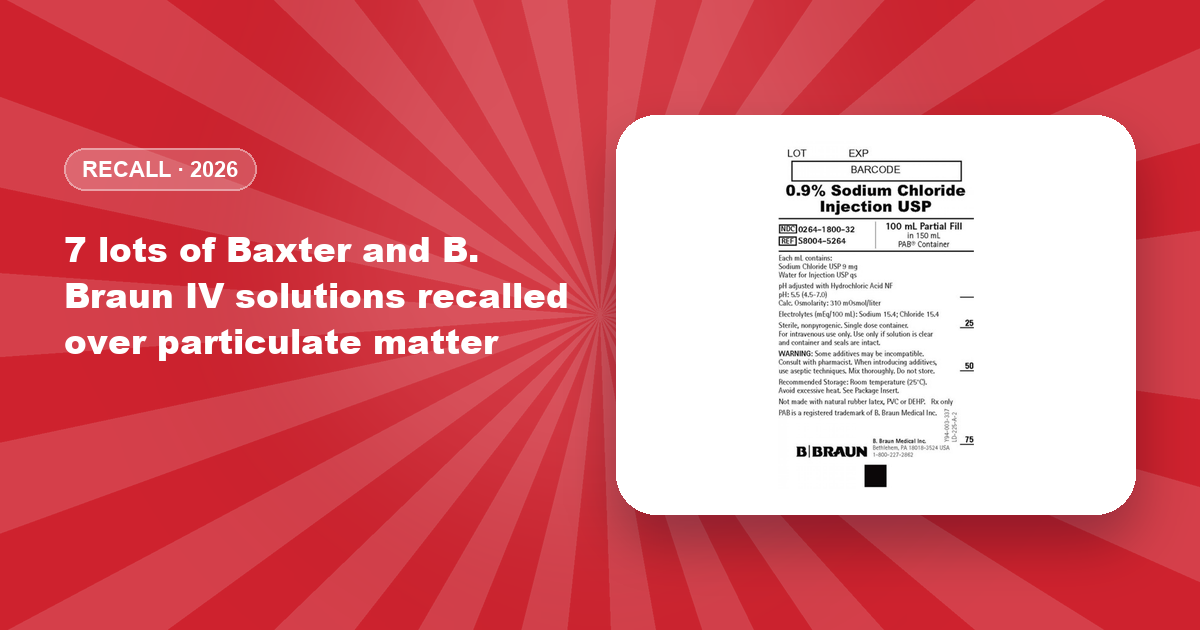 7 lots of Baxter and B. Braun IV solutions recalled over particulate matter
Baxter saline recall explained: 7 lots of Baxter and B. Braun IV saline, 70% dextrose and sodium citrate recalled Aug. 25 to 28, 2026 over particulate matter.
 Lipofit fat burner recalled after FDA finds hidden prescription drug and DNP
The Lipofit recall: FDA found undeclared fluoxetine and DNP in Lipofit Extreme Fat Burner 2.0, lot 25M12F. What the company says to do with the tablets.
 Open settlements this month: deadlines, payouts and proof rules
Open settlements you can still claim this month: deadlines, typical payouts, proof rules and how to file before the window closes.