

16,200 jars of Walmart's bettergoods Pistachio Nut Butter recalled: Class I
bettergoods pistachio butter recall: 16,200 jars of Walmart's 6.7 oz Pistachio Nut Butter (lot LB028ACP04) recalled for Salmonella, Class I. 19 states, refund.
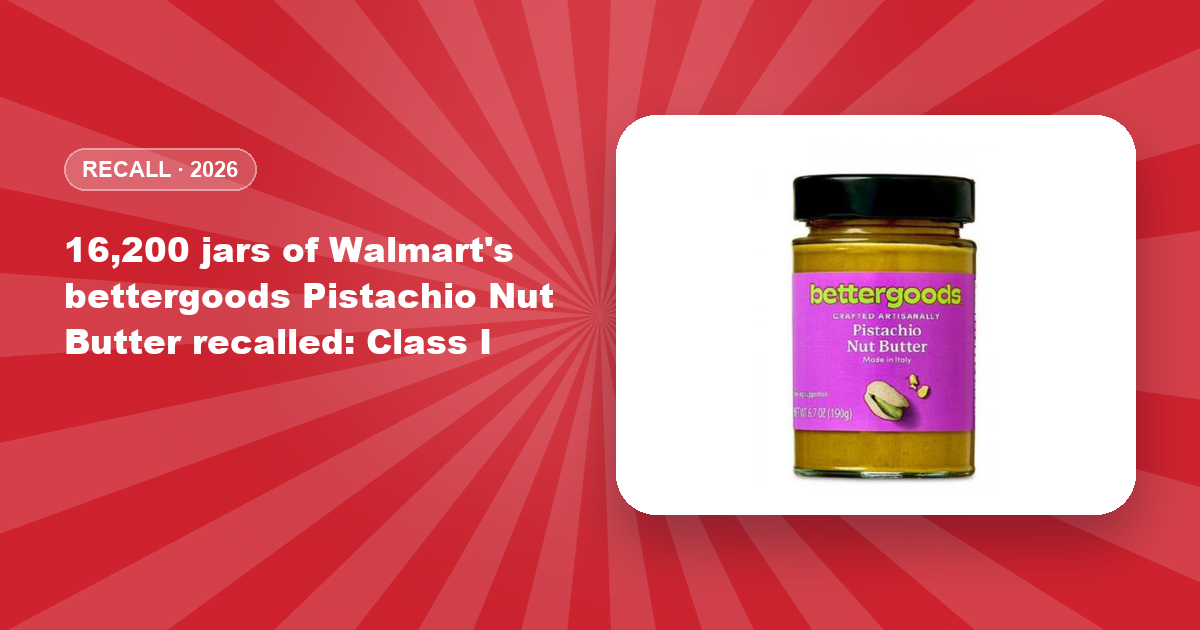
Boticelli Foods of Melville, New York recalled one lot of bettergoods Pistachio Nut Butter, the 6.7 oz (190 g) glass jar sold exclusively at Walmart, after Florida inspectors found Salmonella in three jars; FDA's enforcement record puts the lot at 16,200 units, lot code LB028ACP04, UPC 194346207961, expiration Jan. 28, 2027. The bettergoods pistachio butter recall was announced Aug. 3, 2026 and is not brand-new; it drew fresh coverage in late August after FDA classified it Class I, the agency's most serious category, on Aug. 26, 2026. The jars were shipped to Walmart stores in 19 states, and no illnesses or injuries had been reported as of the notice. Do not eat it; return it to the place of purchase for a full refund.
What was recalled
The product is bettergoods Pistachio Nut Butter, NET WT 6.7 oz (190 g), in a glass jar bearing UPC 194346207961, lot code LB028ACP04, with an expiration date of January 28, 2027 printed on the jar. bettergoods is a Walmart brand, and the notice says the product was distributed exclusively by Walmart Inc. of Bentonville, Arkansas. It was manufactured by Gustibus Alimentari Srl of Assoro, Italy, and imported by Boticelli Foods (which also spells its name Botticelli) of Melville, New York, the recalling firm.
One lot is recalled. The notice states that no other lots of bettergoods Pistachio Nut Butter are subject to the recall, so jars with a different lot code or expiration date are not affected. The recall involves 16,200 units, according to FDA's enforcement record; the company announcement identifies the lot but does not give a jar count.
This is a resurfaced recall. Boticelli's announcement, posted by FDA, is dated Aug. 3, 2026. What brought it back in late August was FDA's Class I classification of the recall, the agency's most serious category, which the enforcement record dates to Aug. 26, 2026. The product, lot and hazard did not change; the classification is what generated the second round of headlines.
Why it was recalled
The recall was initiated after Walmart learned on July 17, 2026 that the Florida Department of Agriculture and Consumer Services (FDACS), as part of a routine inspection, had tested three jars of the product at a Walmart retail store and identified the presence of Salmonella. The notice does not say whether other jars were tested or how Salmonella got into the product.
The company's announcement carries FDA's standard Salmonella language. It notes that Salmonella is an organism which can cause serious and sometimes fatal infections in young children, frail or elderly people, and others with weakened immune systems. Healthy persons infected with Salmonella often experience fever, diarrhea (which may be bloody), nausea, vomiting and abdominal pain. In rare circumstances, infection can result in the organism getting into the bloodstream and producing more severe illnesses such as arterial infections (infected aneurysms), endocarditis and arthritis.
That hazard profile is why the recall drew a Class I designation. FDA defines a Class I recall as a situation in which there is a reasonable probability that the use of or exposure to a violative product will cause serious adverse health consequences or death. The classification describes the hazard, not evidence that anyone has been harmed; the notice reports no illnesses.
Where it was sold
The recalled lot went to Walmart retail stores in 19 states: Alabama, Alaska, Arizona, Colorado, Florida, Georgia, Idaho, Kansas, Mississippi, Missouri, Montana, Nebraska, Nevada, New Mexico, Oregon, South Dakota, Tennessee, Washington and Wyoming. The notice describes distribution as exclusive to Walmart, so the product should not turn up at other retailers.
The notice does not give a sales window, so there is no date range to check against a receipt; the lot code and expiration date on the jar are the identifiers. Because the jar carries a January 2027 expiration, a jar bought before the Aug. 3 announcement could still be in a pantry.
Walmart shoppers have had a run of recalls to keep track of, including the Martina mango recall in Connecticut, New York, New Jersey and Pennsylvania, and the reannounced Mainstays fabric dresser recall. Each has its own identifiers and remedy, so check them separately.
How to identify the recalled jar
Three things on the jar settle it: the UPC under the barcode, the lot code, and the expiration date. All three must match the table below for a jar to be part of the recall. The notice says the recalled product comes in a 6.7 oz (190 g) glass jar bearing UPC 194346207961 and is identified by lot code LB028ACP04, with an expiration date of January 28, 2027 printed on the jar.
If your jar has a different lot code or expiration date, it is not subject to this recall, according to the notice. If the print is smudged or you are not sure, the company's contact line is the place to ask before eating it.
| Product | Size | UPC | Lot code | Expiration | Sold at |
|---|---|---|---|---|---|
| bettergoods Pistachio Nut Butter | 6.7 oz (190 g) glass jar | 194346207961 | LB028ACP04 | January 28, 2027 | Walmart stores in 19 states (exclusive) |
Reported illnesses
No illnesses or injuries had been reported in connection with the product as of the Aug. 3, 2026 notice, in the company's words, "that we are aware of to date." The recall was triggered by a positive test on three jars, not by a sick customer.
FDA's enforcement record does not include illness reports, and its Class I classification is based on the hazard, not on illness counts. If you ate product from the recalled lot and develop the symptoms the notice describes (fever, diarrhea, nausea, vomiting, abdominal pain), contact a healthcare provider and mention the product. Problems with a food can be reported to FDA through its Report a Problem page.
For a sense of scale, the 2026 sprout outbreak involved dozens of confirmed illnesses; this recall, by contrast, is a precautionary pull based on inspection results.
What consumers should do
The instruction in the notice is short. Consumers who have purchased bettergoods Pistachio Nut Butter bearing lot code LB028ACP04 are urged not to consume the product and to return it to the place of purchase for a full refund. The notice does not mention needing a receipt, and it does not describe any alternative such as mailing the jar back or receiving a replacement.
Questions go to Boticelli Foods, not Walmart, according to the notice: email quality@botticellifoods.com or call 631-543-7000, extension 203, between 9 a.m. and 5 p.m. EDT.
- Check the jar for UPC 194346207961, lot code LB028ACP04 and an expiration date of January 28, 2027.
- If all three match, do not eat it, and do not serve it to anyone else.
- Return the jar to the Walmart store where you bought it for a full refund, as the notice instructs.
- For questions, email quality@botticellifoods.com or call 631-543-7000, extension 203, 9 a.m. to 5 p.m. EDT.
- If you have already eaten it and feel unwell, contact a healthcare provider.
- Keep your receipt and a photo of the lot code until the refund is done.
Who issued the recall and when
The recall was announced by Boticelli Foods of Melville, New York as a company announcement dated Aug. 3, 2026, which FDA posted the same day under the product type Food & Beverages with the reason "Possible Salmonella Contamination." The notice says the recall is being conducted with the knowledge of the U.S. Food and Drug Administration. FDA posts company announcements as a public service and does not endorse the product or the company.
The Class I designation is separate from the announcement. FDA classifies recalls in its weekly Enforcement Report after the company has acted, and the classification does not appear on the Aug. 3 announcement page. FDA's enforcement database lists the recall under the firm name Botticelli Foods, LLC, recall number H-1273-2026 (event 99538): Class I, 16,200 units, voluntary and firm-initiated, recall initiation date July 17, 2026, center classification date Aug. 26, 2026, status ongoing, with the Aug. 3, 2026 press release attached.
Why it resurfaced: the Class I classification on Aug. 26, 2026 gave a three-week-old recall a fresh headline, much as an FDA listing update did for the Lundberg jasmine rice recall. The underlying action, the single lot and the refund instruction are unchanged from Aug. 3.
How to monitor recalls and why to keep your receipts
Food recalls with a company announcement appear on FDA's Recalls, Market Withdrawals and Safety Alerts page, and classifications follow in the weekly Enforcement Report. FoodSafety.gov aggregates food alerts; meat and poultry come from USDA FSIS; consumer products from CPSC; vehicles from NHTSA's VIN lookup. Walmart and other retailers also post recall notices, and the brand's own site is worth checking.
Keep your receipt and photograph the jar's lot code, UPC and expiration date before you return it. That documentation may matter if a refund is questioned at the counter, or if a future claim program becomes available; none is described in this notice, and nothing here promises compensation. Owed tracks open class action settlements from companies you have bought from; see the current list.
Glossary
- Class I recall
- FDA's most serious category: a situation in which there is a reasonable probability that use of or exposure to the product will cause serious adverse health consequences or death.
- Lot code
- The batch identifier printed on the jar (here, LB028ACP04). Only jars carrying this code are recalled.
- UPC
- The Universal Product Code under the barcode; the recalled jar carries 194346207961.
- Salmonella
- An organism that, per FDA's standard language, can cause serious and sometimes fatal infections in young children, frail or elderly people, and others with weakened immune systems.
- Enforcement Report
- FDA's weekly listing where recalls receive a classification and recall number, separate from the company's announcement.
- Routine inspection
- A scheduled regulatory check; here, Florida's Department of Agriculture and Consumer Services tested three jars at a Walmart store and found Salmonella.
FAQ
No. Boticelli Foods announced it Aug. 3, 2026. The late-August coverage followed FDA's Class I classification of the same recall on Aug. 26, 2026; the lot and the remedy did not change.
Only bettergoods Pistachio Nut Butter, 6.7 oz (190 g), UPC 194346207961, lot code LB028ACP04, expiration January 28, 2027. The notice says no other lots are subject to the recall.
FDA defines Class I as a situation in which there is a reasonable probability that use of or exposure to the product will cause serious adverse health consequences or death. It describes the hazard, not confirmed illnesses.
Walmart stores in 19 states: Alabama, Alaska, Arizona, Colorado, Florida, Georgia, Idaho, Kansas, Mississippi, Missouri, Montana, Nebraska, Nevada, New Mexico, Oregon, South Dakota, Tennessee, Washington and Wyoming. Distribution was exclusive to Walmart.
As of the Aug. 3 notice, no illnesses or injuries had been reported in connection with the product. The recall was triggered by Salmonella found in three jars during a routine Florida inspection.
The notice says to return the jar to the place of purchase for a full refund. Questions go to quality@botticellifoods.com or 631-543-7000, extension 203, 9 a.m. to 5 p.m. EDT.
- FDA notice — Boticelli Foods Recalls Bettergoods Pistachio Nut Butter Because of Possible Health Risk
- FDA — Recalls background and definitions (Class I, II and III)
- FDA — Enforcement Report database (recall information search)
- FDA — Recalls, Market Withdrawals, & Safety Alerts
This article is based on public information as of Sep 1, 2026; features, prices and deadlines change. Owed is not a law firm and nothing here is legal, tax or financial advice. Corrections →
Keep reading
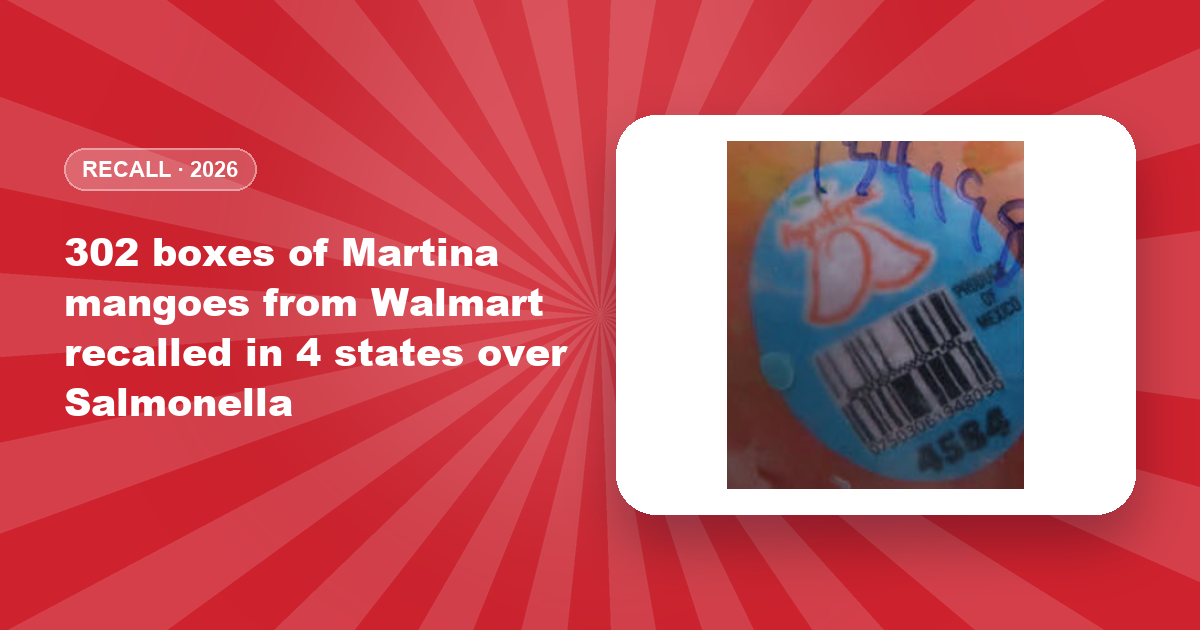 302 boxes of Martina mangoes from Walmart recalled in 4 states over Salmonella
The Walmart mango recall covers 302 boxes of Martina mangoes (PLU 4584) sold in CT, NY, NJ and PA Aug. 10–21, 2026 over possible Salmonella.
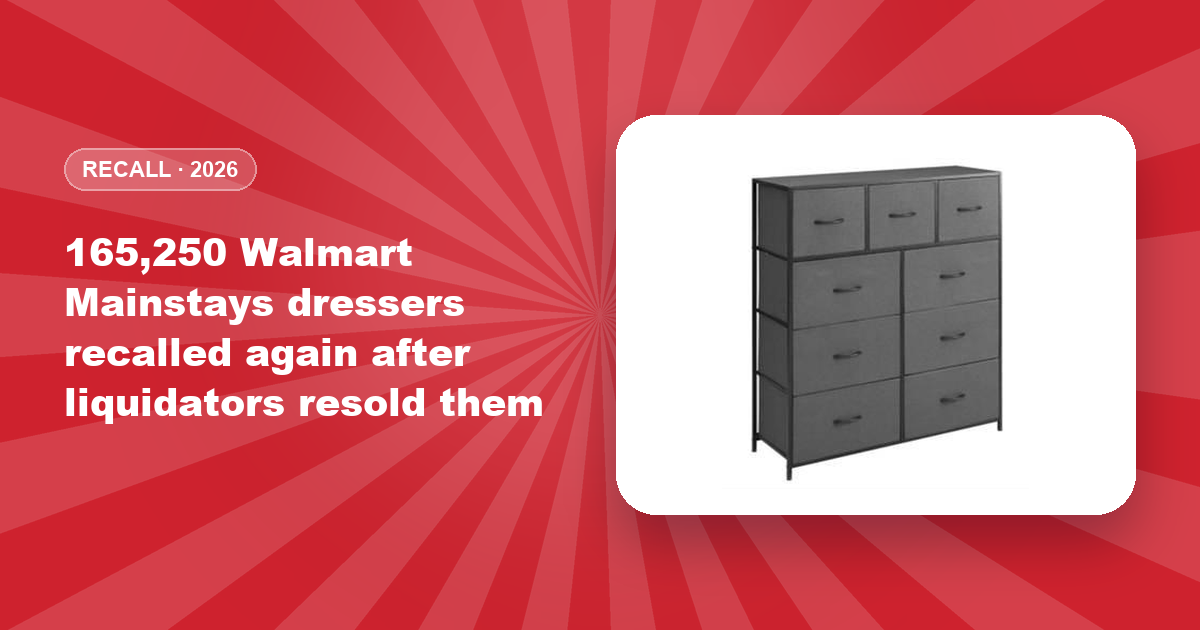 165,250 Walmart Mainstays dressers recalled again after liquidators resold them
Mainstays dresser recall reannounced Aug. 27, 2026: 165,250 Walmart fabric dressers with a tip-over hazard, some resold by liquidators after May's recall.
 Is this settlement email legit? A 2-minute verification checklist
Is that class action settlement email legit? A 2-minute checklist: real administrator domains, claim IDs, what genuine notices contain, phishing red flags.